
If you get a period or spend time with anyone who has a period, you’ve probably heard the term PMS tossed around. “I’m so PMS-y this week”, “Wow she must be PMS-ing”, or my personal favourite: “Are you PMS-ing or something?” (rude lol).
Many people that use the term or know of its truthful (or slightly derogatory) meaning, might not actually know what it stands for.
PMS = Premenstrual Syndrome. That’s what it stands for.
When does it happen? Typically, PMS symptoms are experienced the week or two prior to the start of menstruation and can continue until bleeding ceases (yes, it’s still apparently called PRE-menstrual syndrome even though it can occur during).
What happens? PMS can be different for everyone who experiences it, and can also vary month-to-month.
Some of the common symptoms include:
- mood changes: feeling irritable, angry, anxious depressed, and unstable mood or mood swings
- cognitive changes: sleep disturbances, difficulty focusing, forgetfulness, and confusion
- physical changes: headaches, bloating, water retention, constipation, nausea, low back pain, acne, constipation, cramping or heaviness in low abdomen, breast tenderness, fatigue
Why does it happen? (Theories from a Western Medicine Lens): Estrogen, progesterone, pregnenolone, prolactin, and cortisol (among others) are key hormones in the body that communicate with the ovaries and uterus and play a role in the monthly cycle that female bodies follow. They are at higher or lower levels throughout the month and the fluctuation of these hormones are thought to play a role in PMS. Genetics are also thought to be a factor from a Western standpoint - there may be individual sensitivity to hormonal fluctuations that cause these symptoms.
How does Chinese Medicine conceptualize PMS?
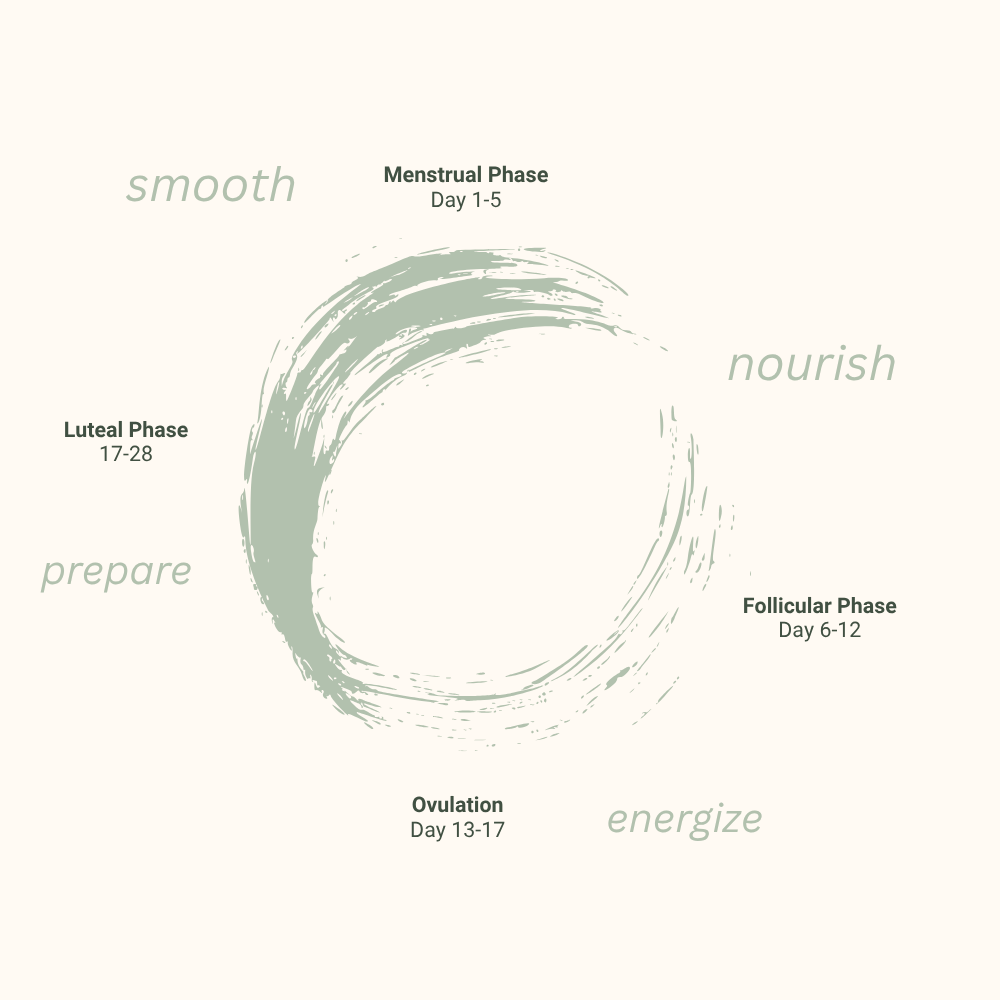
The phases of the menstrual cycle and how to support at each phase. PMS occurs during the Luteal phase, roughly days 17-28 (varies person to person).
It is helpful to conceptualize all of the phases of the menstrual cycle in full to understand what is going on from this perspective and how and acupuncturist would support at each phase of the cycle.
In Chinese Medicine Theory (on which Acupuncture practice is based), PMS is a disease that has an underlying “pattern” or combination of patterns.
The pattern that most of the common symptoms of PMS fall under is known as “Liver Qi Stagnation”. *
The phase at which PMS occurs is known as the Luteal phase, seen above in the diagram. This phase occurs directly after ovulation.
Here the body moves from a very yang state (high energy & intense burst needed for ovulation), into the most yin part of the cycle.
The Liver in Chinese Medicine is responsible for the free flow of qi and blood and when it gets stagnated it causes a disruption in the flow - conceptualized as if there is a kink in a garden hose causing a blockage of proper flow. Part of the preparation for menstruation is to ensure that the channels that carry the blood into the uterus and out of the body are flowing smoothly, and ensuring that our emotions are flowing smoothly as well… if there is stagnation we can experience pain, emotional dysregulation, breast tenderness, bloating, mental confusion, and sleep disturbances (among other symptoms).
*there are often other patterns at play as no one fits into a perfect box, but this is a standard place to start :)
What is the BEST time to come for Acupuncture to support PMS symptoms?
The best time to book acupuncture for PMS is after ovulation, when you’re expecting that the symptoms of PMS are are on the horizon. There is no “perfect day”. Aiming for booking during the timeframe of your luteal phase will be helpful for ensuring things are flowing smoothly in your body as it prepares for your menstruation, and hopefully help you feel better during this time!
(Not always, but commonly supporting the pattern of Liver Qi Stagnation in this part of your cycle can reduce downstream symptoms during menstruation as well!)
References:
Maciocia, G. (2011). Obstetrics and gynecology in Chinese medicine (2nd ed.). Churchill Livingstone.
Modzelewski, S., Oracz, A., Żukow, X., Iłendo, K., Śledzikowka, Z., & Waszkiewicz, N. (2024). Premenstrual syndrome: New insights into etiology and review of treatment methods. Frontiers in Psychiatry, 15, Article 1363875. https://doi.org/10.3389/fpsyt.2024.1363875
The Merck Manual Editorial Staff. (2025, October). Quick facts: Premenstrual syndrome (PMS). Merck Manual Consumer Version. https://www.merckmanuals.com/en-ca/home/quick-facts-women-s-health-issues/menstrual-disorders-and-abnormal-vaginal-bleeding/premenstrual-syndrome-pms
